

The red-eye’s out of JFK, my partner’s on a trip to Seoul, and by the time we’re back in the same zip code we’ve traded exactly one sentence per day: “Who’s picking up the dry cleaning?” That’s the slow way a marriage turns into co-management. Not one big fight. Just a hundred small conversations that never got past the logistics.

The good news: getting back to each other doesn’t require a resort weekend or a perfect date night. It starts with ten phone-free minutes, a real question, and a 20-second hug. Small stuff. Consistent stuff. Here’s what actually works, based on the research and what I’ve learned from my own relationship.
Why Couples Drift Apart (And What It Looks Like)
Emotional distance rarely announces itself. It creeps in through rushed mornings, work stress, and a calendar so full that the only thing left to talk about is what’s left to do. Research indicates the average couple spends less than four minutes a day in meaningful dialogue. Four minutes. That’s one song on the radio.
When the conversations go flat, you stop noticing each other’s small bids for connection — the sigh after a long day, the comment about an article, the glance across a chaotic dinner table. You’re not being cold. You’re running on empty.
How to spot “roommate syndrome” early
When the distance lingers, couples often slip into what feels like a business partnership: shared roof, split expenses, co-managed household — but the romantic pulse is gone. A few signs that it’s asking for your attention:
- Conversations are limited to logistics, chores, and schedules
- You’re parallel-scrolling on your devices in the same room
- Physical contact is reserved for quick goodbyes, or absent entirely
- You share exciting news with friends before telling your partner
- You feel lonely while sitting side by side on the sofa
If this sounds familiar, don’t panic. It’s usually a sign of depleted reserves, not a lack of affection.
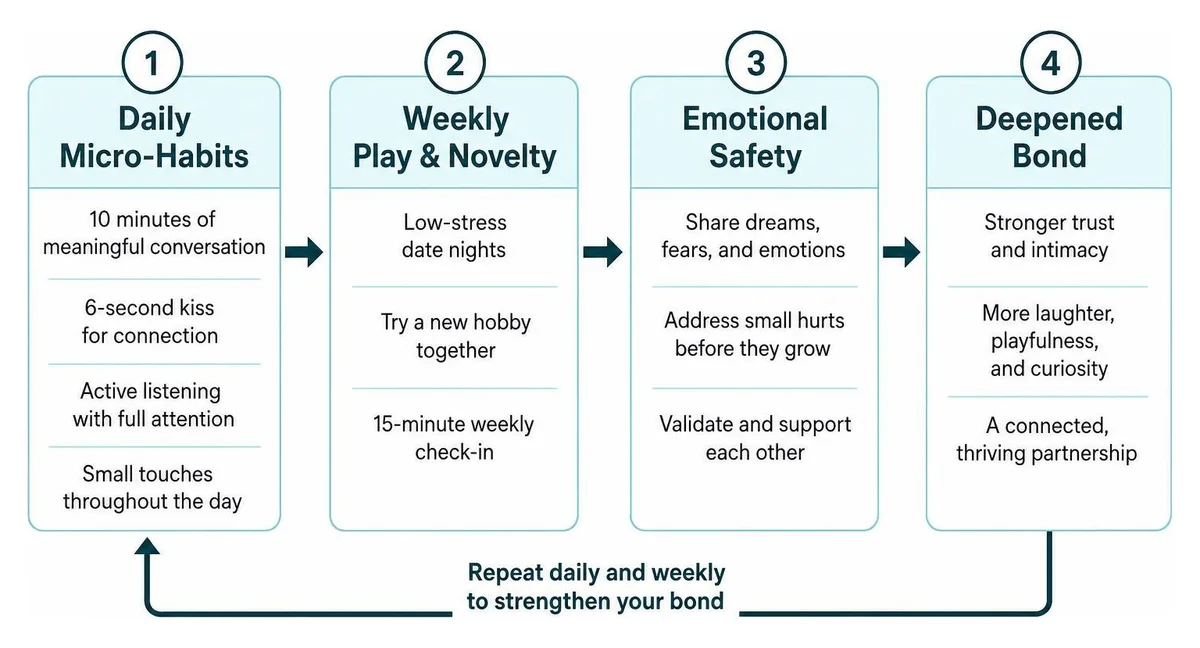
Daily Micro-Habits That Actually Work
Rebuilding closeness doesn’t demand hours of free time. It demands tiny, repeatable moments.
The 10-minute rule
Dr. Terri Orbuch’s 30-year study of over 400 couples found that the happiest partners spend at least 10 minutes every day talking about something other than work, kids, chores, or logistics. Ask one real question: “What was the most interesting part of your day?” or “What’s been on your mind lately?” Then listen without trying to solve it.
The 6-second kiss
Relationship experts note that a six-second kiss is long enough to step out of parent mode and bring intentional warmth back into the morning goodbye or the evening hello. It’s not a lot of time. It’s exactly enough.
Put the phone facedown
Active listening sounds simple and it is. When your partner is talking, reflect their words back before offering advice: “It sounds like you felt really overwhelmed by that meeting.” Listening, it turns out, is an act of love.
Weekly Rhythms for Play and Novelty
Novelty stimulates dopamine in the brain, mirroring the excitement of the earliest stages of dating. You don’t need an expensive night out or a babysitter to get it back. A dessert tasting in the kitchen, a backyard stargazing chat, or a board game night after the kids are asleep gives you uninterrupted time to be playful again.
A few low-stress ways to keep the spark alive:
- Try a new hobby together — a short online cooking class, a gardening project, a shared DIY goal
- Do a weekly check-in: 15 minutes each Sunday evening for highlights, lowlights, and how you can support each other in the coming week
Rebuilding Safety When the Distance Runs Deep
According to the Gottman Institute, emotional safety is the number one predictor of marital satisfaction. When safety is compromised, partners build protective walls to guard against criticism and exhaustion. Rebuilding it means validating each other’s experiences without defensiveness — understanding their perspective, feeling for them, and showing it in small supportive behaviors.
And touch matters more than people admit. Reintroducing casual, non-sexual affection throughout the day — a warm 20-second hug when you reunite after work, holding hands on a walk, sitting close instead of across the room — builds warmth and mutual security. A short handwritten note on the bathroom mirror, or a mid-day text thanking them for something specific, softens guarded dynamics faster than you’d think.
What to Do When One Partner Is Distant
It’s common for one partner to feel the distance more keenly than the other. Approximately 70% of people seeking guidance for marital connection are wives whose partners believe things are “just fine.” If that’s you, here’s what helps:
- Drop the pressure. Avoid asking “Are we okay?” daily — pressure often makes a distant partner withdraw further
- Shift your energy to your own well-being, friendships, and joy. Personal energy benefits the whole relationship
- Make low-stakes bids. A simple invitation — a quick walk around the neighborhood — with no expectations, leads with calm consistency instead of frustration
When to seek professional help
Self-guided habits work wonders, but counseling is worth it when patterns feel deeply entrenched. Consider it if conversations routinely spiral into stonewalling or circular arguments, if an unresolved betrayal keeps damaging trust, or if the distance has persisted for over six months despite consistent effort.
The 2-Minute Fix: Tonight, set a timer for 10 minutes. Phones facedown. One question each: “What was the best part of your day?” No fixing. No scheduling. Just listening. That’s the whole fix. It’s small enough to do even when you’re exhausted — and that’s exactly when it counts.
FAQ
How long does it take to rebuild closeness?
Most couples notice positive shifts within 4 to 8 weeks of consistent, intentional effort. Reconnection is built on sustained “proof of work” — small daily acts of kindness, active listening, and warmth that steadily rebuild emotional security.
What if my partner thinks we’re fine while I feel disconnected?
A perception gap is completely normal. Instead of framing it around what’s wrong, frame it around your own desires: “I love you and value what we have, and I miss having dedicated time just for the two of us.” Propose a quick, low-pressure weekly check-in rather than an overwhelming overhaul.
Can a marriage recover from emotional distance without counseling?
Yes. Many marriages navigate seasons of distance through intentional daily habits, structured communication, shared new experiences, and a mutual decision to prioritize emotional safety at home.
Every long-term marriage moves through different seasons, and drifting apart doesn’t mean your story is finished. Commit to the micro-connections, stay curious, keep it playful — and the warmth comes back. Not as a grand gesture. As a habit.
Note: I’m a beauty buyer turned travel blogger, not a therapist. This is general relationship advice — if things feel deeply stuck, a licensed counselor is always the smarter move.
Claire Bennett is the founder of Glow on the Move — practical skincare and self-care for people who live out of a carry-on. She and her partner, a travel planner, split more flight hours than luggage space, and this post is what they’ve actually kept doing.