
You’re at the boarding gate with a half-empty sunscreen tube that leaked everywhere in your carry-on. The replacement on the airport kiosk says “reef-safe mineral,” costs a fortune, and you’ve got six minutes to decide if it’s worth it.
I’ve been there. Eight years as a beauty buyer flying between New York, Paris, and Seoul taught me one thing: most sunscreen claims don’t survive contact with the science.
So I put together this reference. It’s organized by the myths you actually hear at counters and in your group chats. Everything below comes from peer-reviewed studies or regulatory assessments — FDA, EU, and Australia’s TGA. No brand press releases masquerading as data.
Sunscreen Safety
Both chemical and mineral sunscreens are very safe. Chemical filters like oxybenzone and octocrylene are among the most closely scrutinized ingredients in consumer products. Mineral nanoparticles, too — they don’t penetrate past the dead outer layers of intact skin.
During pregnancy: Chemical sunscreens are considered safe. The safety limits for these filters are based on changes observed in animal fetuses, which represent the most sensitive stage of life. If there were real concerns, you’d see far more warning labels — especially in countries like the US and Australia where sunscreens are regulated as drugs.
For kids: Sunscreens generally aren’t recommended for babies under 6 months, but that’s not just about UV filters — it’s also about other ingredients and the fact that babies have a higher skin-surface-area-to-body-weight ratio.
The FDA GRASE situation
The FDA hasn’t said chemical sunscreens are unsafe. It proposed a change to their “generally recognized as safe and effective” (GRASE) status because more data is needed — that’s it. The same filters have been confirmed safe through EU assessments. The situation is currently in limbo due to animal testing bans.
FDA studies did find chemical sunscreens absorb into the blood, but in minuscule amounts. That finding simply triggered a request for additional safety data, not an alarm bell.
Endocrine disruption
“Potential endocrine disruptor” usually means an ingredient bound weakly to hormone receptors in a test tube. It does not mean it will meaningfully disrupt your hormones at the doses you use on your face.
Benzene contamination
In 2021, Valisure — a lab involved in class action lawsuits and not known for precise measurements — found benzene in some sunscreens. Even with their likely inflated numbers, the amounts detected were not expected to cause noticeable health effects.
Sunscreen Ingredients
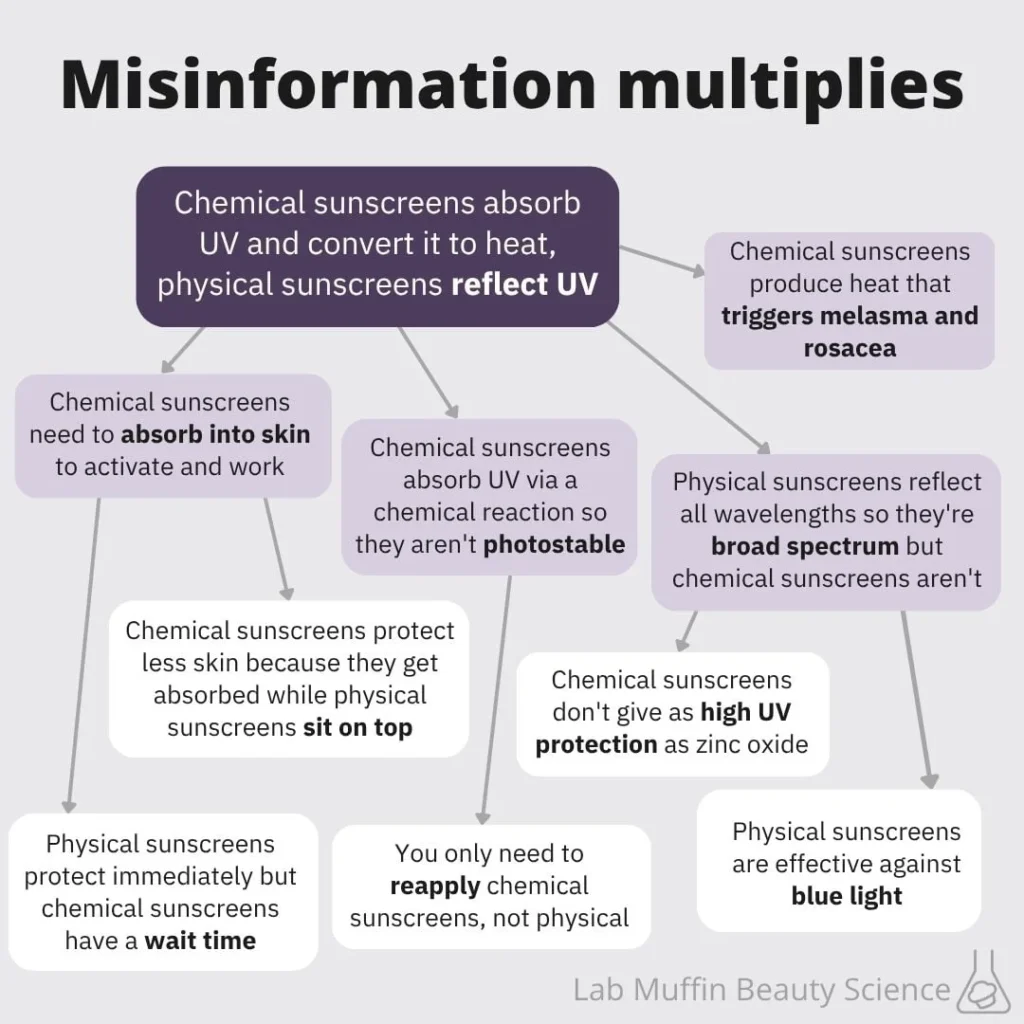
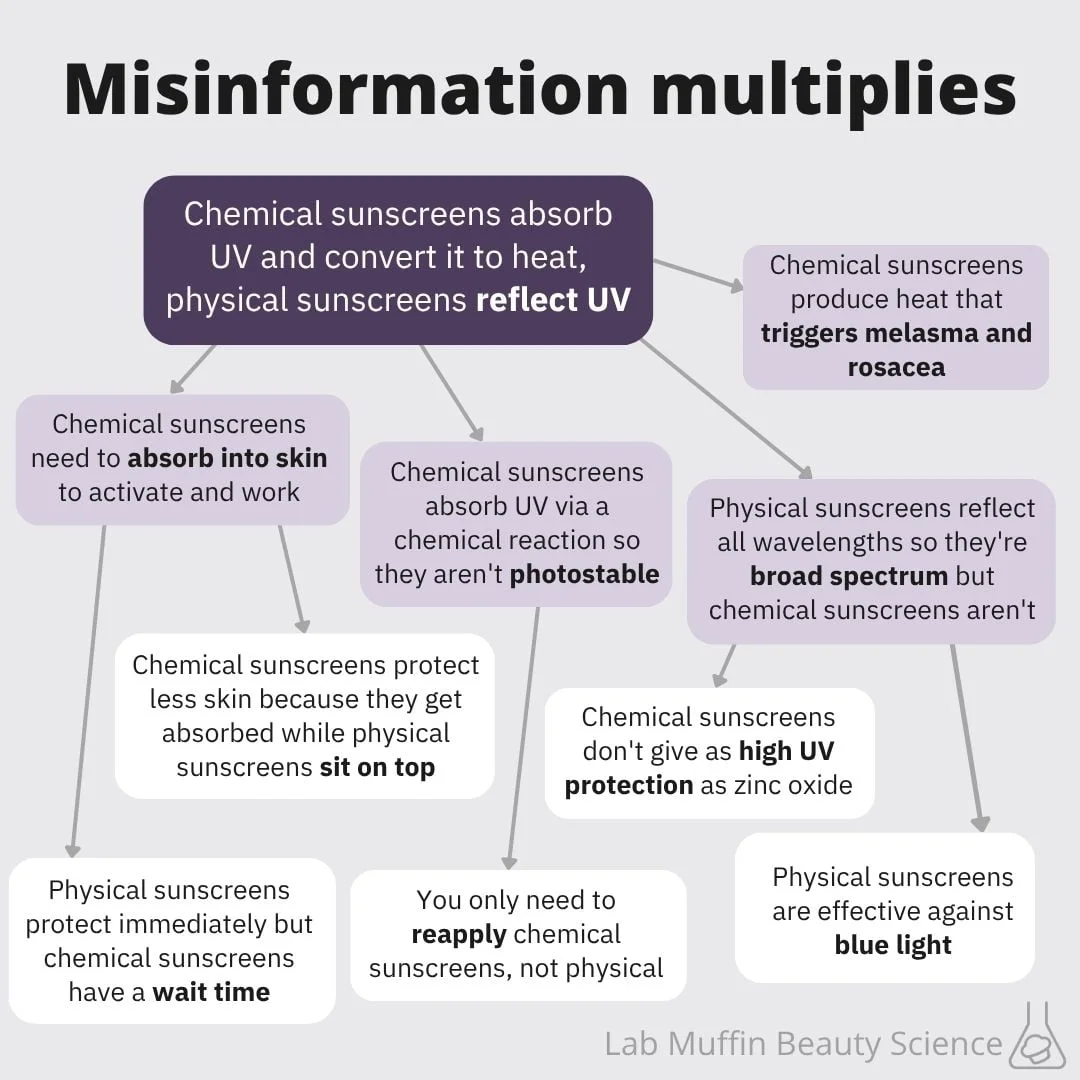
Mineral sunscreens don’t actually reflect UV the way we’ve been told. They absorb 90–95% of it and convert it to heat, just like chemical sunscreens do. This myth is the foundation for a lot of other claims about mineral superiority.
SPF boosters: If a “100% mineral” sunscreen isn’t too whitening, it likely contains hidden chemical SPF boosters. These are nearly identical to standard chemical filters but don’t need to be listed as active ingredients for regulatory reasons. They’re safe — unless you happen to be allergic.
Photostability: Avobenzone doesn’t need to be avoided despite its lower inherent stability. It can be stabilized very effectively. For example, Neutrogena’s Helioplex formulas retain 85% of UVA protection after 5 hours of midday-equivalent sun.
Allergies: Roughly 1% of people are allergic to chemical sunscreens — not 25%, as you’ll often hear.
Using Sunscreen
Chemical sunscreens don’t need to absorb into or react with your skin to work. Apply them over your skincare, just like mineral ones. They start working immediately — the 15- to 20-minute wait time is for all sunscreens and simply lets the product dry down so it doesn’t smear.
How much? There’s no universal “two fingers” rule since finger sizes vary wildly. The tested amount is 2 milligrams per square centimeter of skin, which translates to about 1/4 teaspoon (1.25 mL) for most faces.
Do you need it? Australia’s 2023 sun-exposure guidelines — the most up-to-date evidence-based ones available — recommend sun protection on days when the UV index reaches 3 or over. The latest version even accounts for skin tone.
Reapplication: All sunscreens need it. Most modern formulas are photostable, so the main reason isn’t ingredient breakdown — it’s that the sunscreen film clumps up and wears off over time. A study suggests office workers with minimal movement may still have decent coverage after 8 hours.
Labels: SPF and PA
SPF testing is standardized globally. Most regions use ISO 24444, which involves human volunteers and a UV lamp. “SPF 30” on an Australian sunscreen means the same thing as SPF 30 anywhere else.
Is SPF 50 worth it over SPF 30? Yes. SPF 30 blocks about 97% of erythemal (reddening) UV; SPF 50 blocks 98%. That sounds small, but the UV that gets through is what matters — and SPF 50 lets through roughly three-fifths of what SPF 30 does.
SPF isn’t just UVB. The erythemal action spectrum includes UVA contributions. If you blocked all UVB, you’d only reach about SPF 11.
UVB causes more photoaging than UVA. Despite the “UVA = aging, UVB = burning” shorthand, almost all experimental data shows UVB is the main driver of premature skin aging. UVA also varies with time of day and season — much like UVB does.
Sunscreen Product Types
Sprays: Only about 1/5 to 1/9 of sunscreen sprayed at your face from 20 cm away actually lands on your skin. You’d need roughly 80–120 sprays for labeled SPF on the face. They’re safe with normal use, though.
Sticks: The common recommendation of 4 passes doesn’t hold up for current sticks. Three tested sticks needed an average of 34 passes to hit their labeled SPF.
Lip products: SPF lip products are safe — they’re tested for oral use, including swallowing.
Environmental Impact
The claim that sunscreens bleach coral reefs was mostly based on a single 2016 study that got heavy media promotion. A comprehensive 400-page review by the National Academies in 2022 found that mineral and chemical sunscreens have overlapping environmental impacts — neither is clearly better across all measures. Sunscreen bans were called “premature” and not based on strong data.
Zinc oxide actually has bigger environmental footprints than many chemical filters, especially during production. It’s classified as toxic to aquatic life.
Blue Light
Solar blue light causes longer-lasting tanning in darker skin tones, based on human studies. Mineral sunscreens don’t inherently protect against it — tinted products (foundations, tinted chemical and mineral sunscreens) do a much better job blocking blue light.
Digital screens don’t emit enough blue light to worry about. You don’t need sunscreen in front of your computer.
The 2-Minute Fix
Next time you’re at the airport kiosk or a hotel mini-bar, grab whichever sunscreen you trust and slap it on — mineral or chemical doesn’t matter more than actually wearing it. If your face gets redder than usual after a window seat on a red-eye out of JFK, that’s UVB doing its thing, and 1/4 teaspoon is all the math you need to remember.
FAQ
Is chemical sunscreen safe for kids? Yes. Babies under 6 months are the exception — but due to overall product formulation and their higher skin-surface ratio, not just UV filters specifically.
Does SPF really matter above 30? It does. SPF 50 lets through roughly three-fifths of the UV that SPF 30 allows through. When you’re sitting by an airplane window or waiting at a gate, every bit counts.
Do I need to reapply sunscreen indoors? If you’re mostly still at a desk, you may retain decent coverage for up to 8 hours. But if you touch your face, wipe it, or move between meetings, go ahead and refresh.
Glow doesn’t wait — and neither do you.
Keep Reading
- Is Your Sunscreen Killing Coral Reefs? The Science
- Skin-Saving Skincare Products for a Low Energy Routine
- Sea Salt Scrub Recipe: Black Soap, Shea & Coconut Oil