
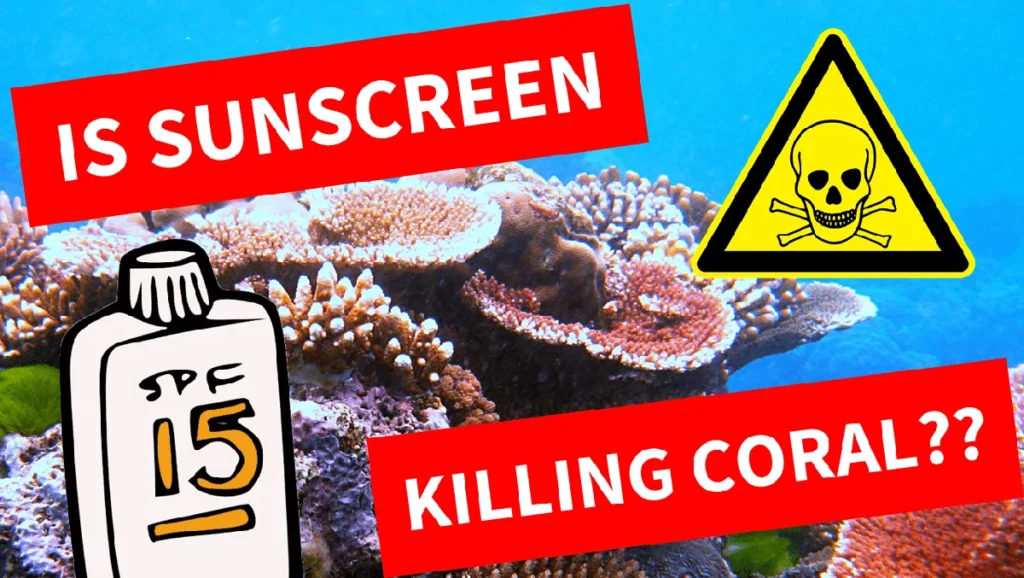
You’re packing for a beach trip, reaching for your reef-safe sunscreen — the one you paid extra for because it says “won’t harm coral.” It feels like the right choice. But what if the science behind that label isn’t quite what it seems?
I’ve been thinking about this a lot lately. Between 30-plus flights a year and every hotel bathroom from JFK to Seoul, sunscreen is one of the few products I never travel without. So when Hawaii banned oxybenzone and octinoxate to protect coral reefs, I grabbed a bottle labelled “reef-safe” without looking twice.
Turns out, a lot of coral experts weren’t convinced. Here’s why.
What Is Coral Bleaching?
Coral live in symbiosis with tiny algae called zooxanthellae inside them. These algae absorb sunlight and photosynthesise to create nutrients — they provide about 90% of the coral’s energy and give it its colour.
When coral is stressed, it expels the algae. The coral turns pale — that’s bleaching. If the stress is temporary, the algae can return. If not, the coral starves and dies.
The main causes? Water temperature changes (climate change), ocean acidification, increased sunlight, and pollutants like herbicides, oil spills, and silt from farming.
What Do the Studies Actually Say?
Several studies on isolated coral samples found that some sunscreen ingredients can cause bleaching. Here’s a quick breakdown of what they showed:
Danovaro et al., 2008 — Hard corals bleached from octinoxate (1.98 ppm), oxybenzone (1.98 ppm) and 4-MBC (0.99 ppm). Other filters like octocrylene, octisalate, and avobenzone had minor or no effects. Bleaching was worst at higher temperatures.
Downs et al., 2016 — Oxybenzone caused bleaching and deformities in multiple coral species at concentrations from 2.28 ppb to 228 ppm. The effect was worse in light.
Fel et al., 2017 — No effect from octocrylene, octyl triazone, ecamsule (Mexoryl SX) or drometrizole trisiloxane (Mexoryl XL). Zinc oxide caused bleaching at 1 ppm but not at 10 ppb.
Corinaldesi et al., 2018 — Uncoated zinc oxide nanoparticles caused rapid bleaching at 6.3 ppm, while coated titanium dioxide had minimal effect at the same concentration. It appears dissolved zinc ions are the culprit, not reactive oxygen species.
The takeaway: oxybenzone and octinoxate show up most consistently as harmful. Zinc oxide is also a concern at higher concentrations — which matters because it’s used at much higher levels in sunscreens than organic filters (up to ~25% vs. below 10%).
Are These Concentrations Realistic?
This is where it gets interesting. The studies used concentrations in the ppm and ppb range, which sound tiny — but they’re much higher than what’s found across most of the ocean.
To put 0.99 ppm of 4-MBC (the lowest effective concentration in the Danovaro study) into perspective: if you applied 30 g of sunscreen containing 3% enzacamene to your entire body and it all washed off as you swam, you’d need to be in just 909 L of water — roughly three bathtubs.
For oxybenzone at 2.28 ppb (the lowest tested in the Downs study), that same 30 g of 6% sunscreen would need to dilute into 790,000 L — one third of an Olympic swimming pool.
The ocean contains about 1.34 x 10²¹ litres of water. That’s roughly 70,000 Olympic pools per person on Earth. Ocean currents also carry pollutants away, so sunscreen is found in barely detectable concentrations (ppt range) across most of the environment.
Higher concentrations that could realistically affect coral do exist — but mostly in secluded bays packed with swimmers. In Hawksnest Bay and Trunk Bay in the US Virgin Islands, oxybenzone levels between 75 ppb and 1.4 ppm have been measured during busy times of day.
The Bigger Picture: Is Sunscreen Really the Problem?
Here’s what most headlines skip: there isn’t solid evidence that sunscreens have actually caused harm to coral reefs in the wild. There’s anecdotal evidence from researchers who’ve seen more degradation near busy swimming areas, but no convincing studies proving it.
In a study of Hong Kong snorkeling hotspots (Tsui et al., 2014), oxybenzone posed an estimated 21% risk of bleaching hard corals and octinoxate, 11%. Danovaro’s team estimated that 10% of the world’s reefs are threatened by sunscreen pollution — though this figure may be generous. It assumes tourists apply 2 mg/cm² twice daily, when most people apply less than 1 mg/cm².
Many researchers think sunscreen’s impact on the vast majority of coral reefs is minuscule. Sunscreen doesn’t even get a mention in recent textbooks and reviews on coral bleaching.
Professor Terry Hughes, director of the ARC Centre of Excellence for Coral Reef Studies, puts sunscreen at number 200 on his list of negative human impacts on coral reefs. He points out that the worst 2016 Great Barrier Reef bleaching occurred in the remote Northern region — far from tourist hotspots — and correlates with rising water temperatures from climate change.
As he put it: “There is actually no direct evidence to demonstrate that bleaching due to global heating is exacerbated by sunscreen pollutants. Similarly, there is no evidence that recovery from thermal bleaching is impaired by sunscreens, or that sunscreens cause coral bleaching in the wild.”
Fellow researchers Gorospe and Humphries at the University of Rhode Island call damage from sunscreen “negligible against the backdrop of what really is threatening reefs — climate change.” Coral scientists Carys Mitchelmore and Doug Fenner say they’re frustrated that a single, unreplicated study on oxybenzone is taking spotlight away from scientifically proven concerns.
Banning sunscreens to save reefs helps, sure. But it’s like polishing your doorknob when your house is burning down.
The NOAA Page: An Update Worth Noting
The National Academies released a 400-page report in August 2022 reviewing sunscreen’s environmental impacts. It flagged the popular NOAA page on “Skincare Chemicals and Coral Reefs” as an example of early research being oversold to the public.
NOAA updated their page in 2022, but the core infographic — which lists specific ingredients to avoid — hasn’t changed since. The author emailed them about it; the Coral Reef Conservation Program’s communications director pushed back, suggesting readers contact the study authors directly for deeper questions. As of mid-2025, the page still reads as though mineral sunscreens are universally reef-safe, even though the National Academies report found overlapping toxicities between chemical and mineral filters.
What Can You Do?
Avoid harmful sunscreens when swimming near coral. Sunscreen’s effect is negligible for most of the ocean, but if you’re in the water close to reef areas, it’s worth being mindful. Maximise other protections first — shade, sun-protective clothing — so you use less sunscreen on exposed skin.
Know your ingredients:
- Harmful: oxybenzone, octinoxate, enzacamene (4-MBC), zinc oxide
- Minimal harm or no effect: octocrylene, octisalate, avobenzone, octyl triazone (Uvinul T), ecamsule (Mexoryl SX), drometrizole trisiloxane (Mexoryl XL), titanium dioxide
- Unknown: bemotrizinol (Tinosorb S), bisoctrizole (Tinosorb M), Uvinul A Plus, ensulizole, homosalate
Sunscreen options with coral-friendlier formulas:
- Stream2Sea SPF 30 Sunscreen
- Cancer Council Ultra SPF 50+ Sunscreen
- La Roche-Posay Anthelios Activewear Lotion Sport Sunscreen
- Headhunter Sunscreen SPF 50
- Supergoop! Everyday Sunscreen SPF 50
- Coppertone Sport Sunscreen Lotion SPF 50
Read the actual ingredients, not just labels like “reef-friendly” or “biodegradable.” Some sunscreens labelled reef-safe still contain oxybenzone. And zinc oxide — often assumed to be safe because it’s a mineral filter — can actually be worse for coral than many chemical filters at the concentrations used in products.
Apply sunscreen 20 minutes before entering the water and choose formulas with high water resistance to minimise what washes off.
Act on climate change. This is the one that matters most. Cut down on the biggest contributors to your carbon footprint — driving, long-haul flights, eating meat. Opt for a green energy provider. Vote for leaders who treat climate change seriously. Because if we want to save coral reefs, sunscreen alone won’t cut it.
The 2-Minute Fix
Next time you pack sunscreen for a trip near the coast, check one thing on the ingredient list: does it contain oxybenzone or octinoxate? If yes and you’ll be swimming close to coral, swap it for a formula with titanium dioxide instead. Small change, zero extra effort.
FAQ
Are mineral sunscreens always reef-safe?
Not necessarily. Titanium dioxide shows minimal harm in studies. Zinc oxide, however, causes bleaching at similar concentrations to oxybenzone — and it’s used at much higher levels (up to ~25% vs. below 10%). So “mineral” doesn’t automatically mean safer.
Does nano vs. non-nano zinc oxide matter for coral?
Published studies tested only nanoparticles, but research suggests dissolved zinc ions are the main toxic species — and both micro- and nano-zinc oxide release similar amounts of zinc ions, so the difference may be minimal.
Should I stop using sunscreen altogether to help coral?
No. The effect is mostly relevant when swimming near reefs. For everyday use, wear whatever sunscreen you like — but focus your environmental efforts on climate change, where the impact is far greater.
Glow doesn’t wait — and neither do you.
Keep Reading
- Skin-Saving Skincare Products for a Low Energy Routine
- Sea Salt Scrub Recipe: Black Soap, Shea & Coconut Oil