
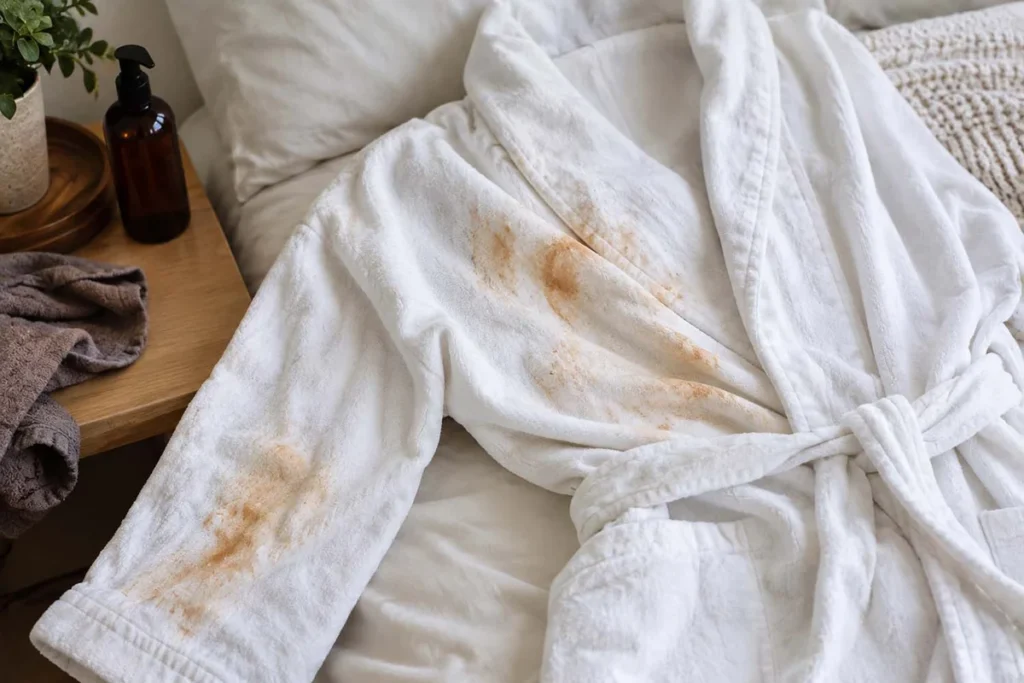
The red-eye was at 6 a.m., my carry-on was already zipped, and I was doing the last at-home self-tanner application of the season — in my hotel room, on my good white robe. I’d read the instructions. I’d waited out the full development time. I’d even thrown an old t-shirt underneath as a buffer. None of it mattered. I woke up to faint orange-brown smudges down one sleeve and across the front, right where the robe gaped open overnight.
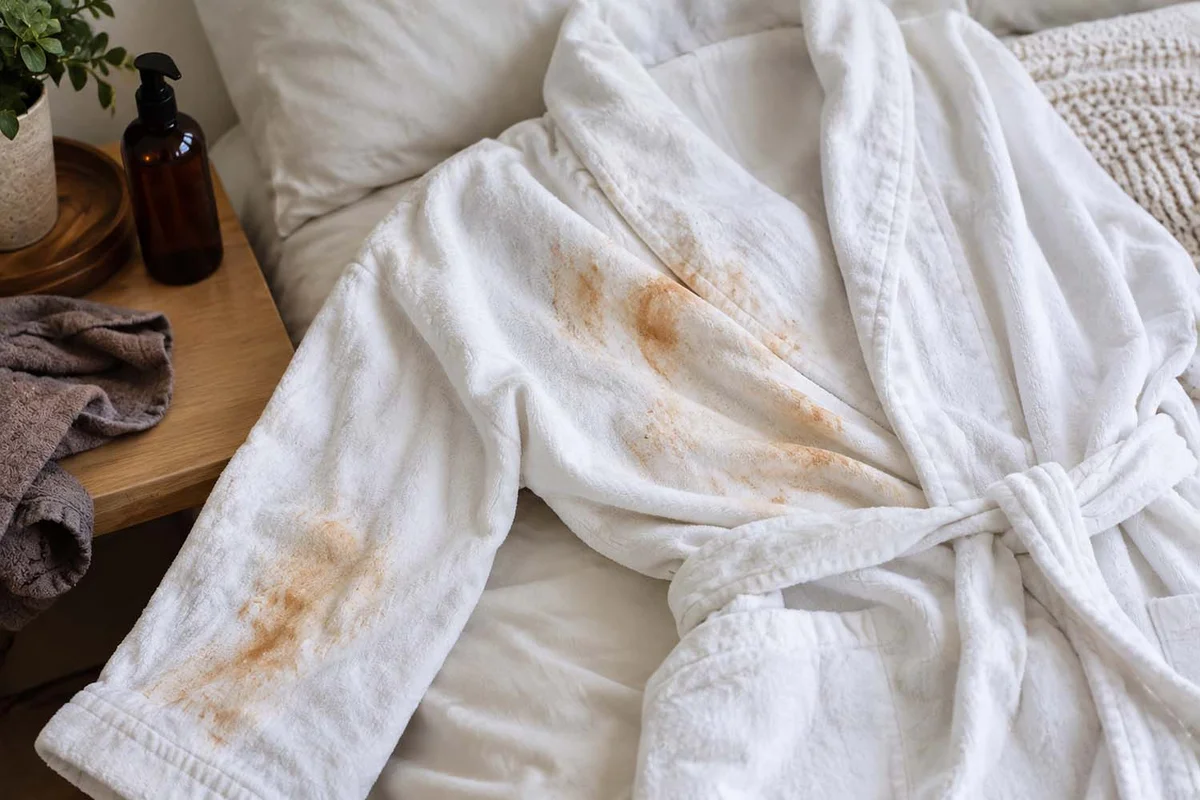
My first guess was that the tanning chemical had bonded to the fabric and the robe was done for. That guess was wrong — and once I figured out what was actually staining the cloth, every self-tanner stain since has been a routine instead of a disaster.
The Short Answer
Rinse the stain with cold water from the inside of the garment first, then work in a mix of dish soap and warm water to break down the oils and bronzer dye that are actually doing the visible damage. If it’s dried or been sitting overnight, skip straight to an oxygen bleach soak. Keep hot water and the dryer away until the stain is confirmed gone — and treat silk or wool as urgent, because those are the only fabrics that can genuinely bond with the tanning agent itself.
Why This Stain Isn’t Like Any Other Cosmetic Stain
Most guides treat self-tanner like a generic oily makeup stain — hit it with dish soap and call it a day. That’s why so many people swear the stain is gone, wash the garment, and then find a faint ghost of it back a few washes later.
Here’s the piece most people miss. The active ingredient in nearly every self-tanner is dihydroxyacetone, or DHA. On its own it’s colorless, and it doesn’t behave like a dye. Chemists note that it works through the same browning chemistry that turns bread crust golden — the Maillard reaction — reacting with the amino acids in the outer layer of your skin. That reaction is slow, which is exactly why tanner stains often don’t show up until morning, long after you’ve forgotten the application.
Cotton, polyester, and most bedding don’t have the free amino acids DHA needs to trigger that reaction, so the fabric itself resists true browning. What actually stains your clothes is everything riding along with the DHA: the guide-color bronzer dye added so you can see where you’ve applied the product, plus the oils in the base formula. That’s a removable dye-and-oil stain, not a chemical bond. Good news.
The Golden Rule: Treat the Fabric, Not Just the Formula
Here’s the part almost no other guide mentions, and it’s the reason silk and wool deserve more urgency than cotton. Both are true protein fibers, built from the same amino acid blocks as your skin’s outer layer. Researchers have even used this exact chemistry on purpose — applying DHA to wool under controlled heat to dye it through the wool’s keratin. So on those fabrics, DHA can react directly with the fiber, not just sit on the surface. A stain on a silk blouse or wool sweater can be a genuine chemical reaction happening inside the fiber, and it deepens the longer it sits — the same way your skin keeps darkening for hours after application.
Nylon is where people get confused. It shares a similar chemical bond to wool and silk, which is why it’s sometimes lumped in with them. But nylon is a synthetic polymer, not a natural protein, and there’s no established evidence it reacts with DHA the way wool does. Treat nylon like any other synthetic: no special urgency, dish soap and a standard wash handle it.
That’s why a splash on a cotton t-shirt is a same-day annoyance, while the same splash on a silk blouse is a race against a slow chemical clock.
Stain Variants: Fresh, Dried, Overnight
- Fresh (still damp or tacky): the easiest case. The dye and oils haven’t set. A cold water rinse followed by dish soap will usually lift the whole thing in one pass.
- Dried, same day: the dye has set on the surface, but any deeper reaction hasn’t fully developed. Dish soap plus a short soak in cool water still works well.
- Overnight or fully set, cotton and synthetics: the bronzer has oxidized and bonded to the surface fibers. This is where an oxygen bleach soak earns its keep.
- Overnight or fully set, silk or wool: treat as urgent. DHA has had time to react directly with the protein fibers. Oxygen bleach can still help, but full removal is less certain — for anything valuable, a professional cleaner may be your best bet.
How to Get Self-Tanner Out of Clothes: 4 Methods That Actually Work
1. The Cold Flush and Dish Soap Blot (fresh stains, all fabrics)
Turn the garment inside out and run cold water directly onto the back of the stain, pushing it out and away from the fibers. Mix a few drops of liquid dish soap with warm water, dip a clean cloth in it, and blot from the outer edge toward the center. Don’t scrub. Rinse with cold water and check the stain in good light before washing as usual. Verdict: works on the majority of fresh stains, and should always be your first move.
2. The Overnight Oxygen Bleach Soak (dried or set stains)
Mix an oxygen bleach powder according to the package directions in cool to lukewarm water, and submerge the stained area for at least 6 to 8 hours, or overnight. Oxygen bleach oxidizes the bronzer pigment without the fiber damage or color stripping that chlorine bleach causes. Rinse thoroughly and inspect before drying. A small tub of oxygen bleach powder is worth keeping on hand specifically for this. Verdict: the single most effective step for a stain that’s already dried.
3. Enzyme Pretreatment (mixed formulas, tanner-plus-sunscreen combos, sweat transfer)
Many self-tanners are blended with moisturizers or SPF, or they pick up sweat from an overnight wear — all of which add protein or fat components that oxygen bleach alone won’t fully break down. Apply an enzyme-based stain remover directly to the stain and let it sit for 15 to 20 minutes before washing. Skip this step on silk and wool, since enzyme formulas are built for protein stains and can be too aggressive on protein fibers themselves. Verdict: a strong second step layered after the dish soap or bleach stage on cotton and synthetics.
4. The Portable Field Treatment (activewear, on-the-go spots)
If you catch a stain on leggings, a sports bra, or a shirt away from home, a stain remover pen can hold the line until you get to a proper wash. It won’t fully remove a set bronzer stain, but it keeps the oils from spreading or setting further in the meantime. Verdict: a stopgap, not a fix — but a genuinely useful one to keep in a gym bag or carry-on toiletry kit.
Pro tip: keep an oxygen bleach powder and an enzyme stain remover in the same drawer as your self-tanner. The window between a same-day fix and an overnight chemical bond is short, and having both on hand means you’re not improvising with whatever’s under the sink at 1 a.m. before a flight.
By Fabric Type
- White cotton: the most forgiving fabric here. Dish soap followed by an oxygen bleach soak handles nearly everything, and white cotton tolerates a longer soak than colored pieces.
- Colored cotton: same approach, but test the oxygen bleach on an inside seam first. Most modern formulas are color-safe, but pigment-dyed fabrics can occasionally lighten with extended soaking.
- Linen: treat quickly with dish soap. Limit any oxygen bleach soak to one to two hours rather than overnight — extended soaking can yellow the flax fibers over time.
- Polyester and activewear synthetics: dish soap lifts most of the surface stain easily, since synthetic fibers don’t absorb oils the way natural fibers do. Rinse well, since residue can attract dirt on activewear if left in the fibers.
- Silk: treat as urgent. Cold water flush immediately, then a gentle dish soap blot — never a scrub. Skip enzyme treatments. If it’s been sitting overnight, a professional cleaner familiar with protein-reactive stains is a safer bet than repeated home treatment.
- Wool: same urgency as silk. Cold water only, gentle blotting, and avoid wringing or twisting the fibers, which can felt the wool while it’s wet.
- Nylon: a synthetic, not a true protein. Dish soap plus a short oxygen bleach soak if needed, the same way you’d handle polyester.
- Dry-clean-only fabrics: blot gently with a cool, damp cloth to keep the stain from spreading, then take it to a professional as soon as possible and point out the stain so they can pretreat it before the standard cleaning cycle.
Preventing the Stain in the First Place
The easiest self-tanner stain to remove is the one that never happens. Give the product a full 8 to 12 hours to finish developing before you get into bed or put on light-colored clothing, and shower off any residue first. Sleep in an old t-shirt or dark pajamas, and keep dark or old bedding on tanning nights rather than your white set. Sweat is one of the biggest transfer culprits — it reactivates surface residue even after the product feels dry — so keep the room cool and consider a light dusting of baby powder on areas prone to sweating. And if you’re using a tinted mousse or lotion, know that the guide-color dye is doing most of the staining: a clear or lightly tinted formula transfers far less to fabric than a deeply bronzed one.
The 2-Minute Fix
Garment inside out. Cold water straight onto the back of the stain for 30 seconds. Then a cloth with a few drops of dish soap in warm water, blotted from the outer edge toward the center. No scrubbing, no dryer. That’s it — the stain is out before you’ve lost two minutes, and the robe survives the season.
What Doesn’t Work
Toothpaste is a common home remedy for small self-tanner spots, and it can occasionally work on white cotton in a pinch. But most toothpastes contain mild abrasives and whitening agents that aren’t formulated for fabric and can bleach colored garments. Not a reliable fix — and not one to reach for on anything but plain white cotton.
A lemon juice and salt scrub shows up in a lot of older home-remedy roundups. The abrasive texture can help lift dried pigment from sturdy cotton, but it’s rough on delicate fabrics and inconsistent even on the fabrics it’s meant for. Last resort, not first move.
A generic stain stick alone will often fall short on a set, overnight stain, since the browning byproducts behave more like a food-browning stain than a simple surface dye. A stain stick helps as pretreatment, but it isn’t a substitute for the oxygen bleach soak on anything that’s had time to set.
The One Thing I Wish I’d Known Sooner
I spent that first morning scrubbing my robe with regular laundry detergent, assuming I was fighting the tanning chemical itself. I wasn’t. I was fighting a dye and an oil, both of which came out completely once I switched to an oxygen bleach soak instead of more scrubbing. The tan itself — the actual DHA reaction — never touched the cotton at all. Knowing that changed how urgently I treat a stain now: fast and simple for cotton, but genuinely urgent for anything silk or wool, because those fabrics really can bond with the tanning agent the way skin does.
FAQ
Does self-tanner stain clothes permanently? Rarely, if treated within a few days. Cotton and synthetics almost always release the stain with an oxygen bleach soak. Silk and wool carry more risk of a lasting mark, since the tanning agent can bond directly with the protein fibers.
Does self-tanner come out of white sheets? Yes. White cotton sheets respond well to dish soap followed by an oxygen bleach soak, and white fabric tolerates a longer soak than colored pieces.
Will chlorine bleach remove a self-tanner stain? No. Chlorine bleach can react unpredictably with the bronzer dye and set or worsen the discoloration. Use oxygen bleach instead.
How do you get self-tanner out of towels? Treat them like cotton sheets: cold rinse, dish soap, and an oxygen bleach soak if the stain has already dried. Terry cloth’s texture actually helps release pigment more easily than smooth cotton.
How do you get self-tanner off carpet or a couch? Blot immediately with a dry cloth to lift as much as possible, then dab — don’t pour — a dish soap and water solution onto the spot, working from the outer edge in. For upholstery you can’t submerge, a small amount of oxygen bleach solution dabbed on and blotted dry works better than a full soak. Test any spot treatment on a hidden corner first.
Self-tanner stains look alarming because they show up gradually, often overnight, but the fix is straightforward once you know what you’re actually treating. Cold water, dish soap, and an oxygen bleach soak handle the vast majority of cases. Save the extra urgency for silk and wool, and skip the dryer until you’re sure the stain is gone. Glow on, even on the move.